
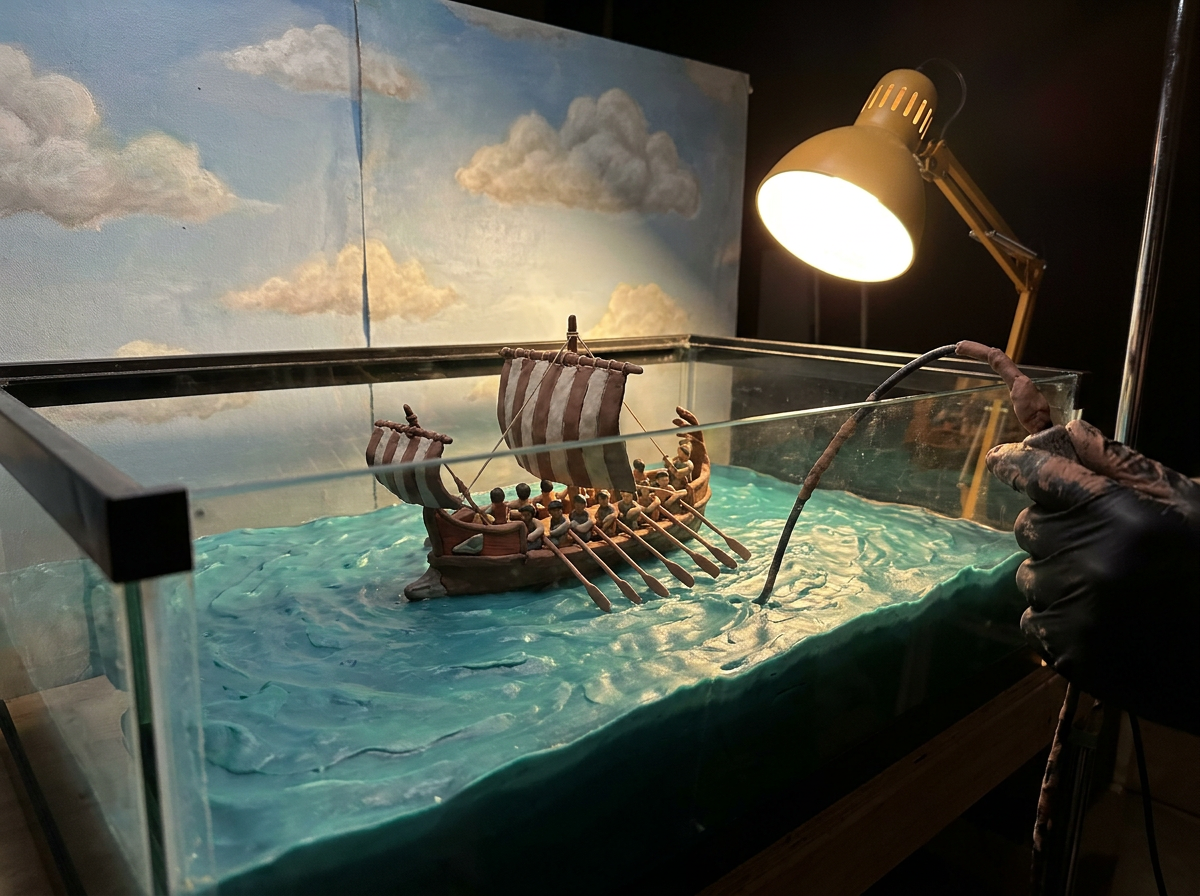
Date night. Three hours and thirty-two minutes of Ben-Hur, which is a lot of movie to put in front of a marriage on a weeknight, and which my wife and I did anyway.
I’d seen it before. I had not seen it this time. Somewhere around the galley sequence I started noticing threads I’d walked past on every previous viewing, and by the time the credits rolled I had two of them in hand and a third that only showed up later, when I started asking what the thing had actually cost to make.
They turn out to be the same thread.
I. The scene the script doesn’t contain
Messala comes home. He’s been away for years. He walks into the house of the man he grew up with, and the reunion plays with an intensity that the dialogue does not remotely earn.
They cross spears in a shaft of light. They drink. Messala offers a toast — Down Eros, up Mars — a line lifted almost intact from Shakespeare’s Antony, spoken by a Roman putting away love and picking up war. And then, over the following scenes, Messala asks Judah to inform on his own people, Judah refuses, and a friendship becomes the engine of a three-and-a-half-hour revenge picture on the strength of a political disagreement that, on paper, is about a tax roll.
On paper it does not hold. On screen it holds completely. Something is carrying the weight that isn’t in the words.
Gore Vidal spent forty years claiming to know what. Vidal was one of several uncredited writers churning through the script, and his account — repeated in interviews and eventually on camera in The Celluloid Closet — is that he pitched William Wyler on playing the reunion as the reunion of two men who had been lovers as adolescents. Messala returns expecting to resume. Judah won’t. The rejection is what turns him. Vidal said Wyler agreed to try it, that Stephen Boyd was told, and that Charlton Heston was deliberately not told, on the theory that a Heston who knew would play against it.[1]
Heston denied this with real heat for the rest of his life, and credited Christopher Fry with most of the finished dialogue. Wyler was characteristically vague. The documentary evidence is thin — Vidal’s own testimony and a publicist’s note — so file the origin story as contested rather than established.
But the scene plays how it plays. Boyd is doing something with his eyes that Heston is manifestly not doing back, and the asymmetry is the whole point. Whether Vidal invented the technique or invented the anecdote, the technique is on the film.
And there’s a second one, which almost nobody discusses. The galley sequence is built out of looking. Quintus Arrius takes an interest in Number 41 that the screenplay never bothers to motivate — he singles him out, he comes below decks to watch him, he unchains him against every operational instinct a Roman consul should have. It resolves in adoption. Arrius gives Judah his name. That’s a legible Roman patron/protégé structure and Jack Hawkins plays the devotion absolutely straight, which is precisely why it registers.
Here’s the part worth sitting with: the Production Code made subtext a craft discipline. You could not write the scene, so you learned to build it out of blocking, eyeline, and the space between two actors who have been told different things. Directors developed a whole grammar for saying what they were forbidden to say. It was a constraint, and it was a genuine artistic risk — get caught and you lose the seal, lose the seal and you lose the theaters — and out of it came a body of technique that only exists because the technique was necessary.
Hold that thought.
II. The other thread, which is also unstated
The second thing I caught was that this is a Jewish film about Roman occupation that declines, quietly and consistently, to do the thing its genre was built to do.
Lew Wallace’s 1880 novel is subtitled A Tale of the Christ, and it’s a conversion narrative in the strict sense. Judah expects a military liberator, raises legions in Galilee to fight alongside him, and the arc is the discovery that it isn’t that kind of kingdom.
Wyler keeps the structure and drops the temperature by about forty degrees. He was Jewish, making this fourteen years after the camps, and the picture is conspicuously careful in ways that look like directorial signature rather than accident. Christ is never shown face-on — you get other people’s faces reacting, which puts the emphasis on response rather than iconography. Roman authority owns the crucifixion outright. And Judah is never converted in any doctrinal sense. No baptism, no renunciation of anything except vengeance. I felt his voice take the sword out of my hand.
That’s a Jewish man responding to a Jewish teacher under the same occupation. The film sets up the supersessionist move that the genre expected — Judaism as the thing being replaced — walks right up to it, and simply doesn’t make it.
The chiasmus is the tell. Christ gives Judah water at Nazareth as he’s marched toward the galleys; Judah gives Christ water on the road to Golgotha. Two men, same road, opposite directions, no commentary.
Which is where the two threads meet. The film is fundamentally about occupation and collaboration. Messala isn’t a thug; he’s an assimilated colonial administrator from a good family, absolutely certain that history is on his side, asking a local notable to inform on his neighbors. You’re either with me or against me. If there was ever anything between them, the political betrayal is also an intimate one — and that is the load-bearing reason a heel turn that thin can support the weight of the picture.
None of it is stated. All of it is built.
III. The joy of the thing
Then there’s the raft.
After the sea battle, Judah and Arrius are adrift, and the shot is unmistakably a studio tank in front of a painted backing. It looks fake in a way nothing else in the movie does. It looks fake in 4K, on a modern transfer, sixty-seven years later.
That turns out to be a consequence of ambition rather than laziness, and chasing it down opened up the most purely enjoyable rabbit hole I’ve been down in a while.
Ben-Hur was shot in MGM Camera 65: a 65mm negative with a 1.25x anamorphic squeeze, producing a 2.76:1 image on the 70mm print. Robert Surtees ran three camera crews and six 65mm bodies, often all rolling at once on the spectacle days, and burned through more than a million feet of Eastman Color negative in Italy.[2] A negative that large resolves everything, including its own seams. Practical sets and real horses look magnificent. A painted backing has nowhere to hide.
And the raft is the one sequence in the film that had to be a composite — two actors held in close, sustained wide shot against open sea. In 1958 there was no mature 65mm process-plate or optical-printing infrastructure the way there was for 35mm. Everything else in the production is engineered specifically to avoid that problem. The raft is where they couldn’t.
So what did they build instead?
Essentially all of it. The film was photographed entirely in Italy — three hundred sets across 148 acres and nine sound stages, largely at Cinecittà.[3] The desert was supposed to be Libya; the Libyan government pulled the permit on religious grounds a week before shooting was to begin, so the desert you’re watching is improvised out of Italy. The mountain village of Arcinazzo Romano east of Rome plays Nazareth. The beaches near Anzio play the oasis. Caves south of Rome play the leper colony.
The chariot race is the answer to the obvious question of why you’d bother. You can’t do it on a stage, so they didn’t. The arena ran 2,000 feet by 65 feet, covered eighteen acres, was the largest single set in motion picture history to that point, and reportedly took 40,000 tons of imported white sand and a full year to build.[4] Fifteen thousand extras. Eighteen chariots, half of them reserved for practice. Five weeks to shoot. Andrew Marton ran second unit with Yakima Canutt on stunts, and Glenn Randall — Trigger’s trainer — spent eleven months in Italy matching horse teams by temperament and then by color, with a set of blacks assembled for Messala.[5]
The moment everyone remembers, where Judah is pitched forward over the front of his chariot and has to climb back in, is a genuine accident. Joe Canutt, doubling Heston, dropped the reins and grabbed the rail against his father’s explicit instruction. Wyler kept it and cut in a shot of Heston recovering. There is no version of that shot that a storyboard produces.
And then the beautiful inversion: the sea battle, the sequence that looks like location work, was shot first, in a tank on the MGM back lot in Culver City, with more than forty model ships.[6] Buddy Gillespie’s department built the hero galleys at 1/6 scale and populated the decks with molded rubber figures on poseable wire armatures — some rigged to walk, others mounted on springs so they’d twitch rather than stand there like furniture. Motors worked the oars. Distant ships were smaller; the most distant were photographs of the models mounted on flat cutouts and pulled along tracks outside the tank. The camera ran at 72 frames per second while the ships moved about a foot per second, because water doesn’t scale — so you slow time instead.[7]
The galley section of this movie is therefore a three-way stitch: miniatures in California, the rowing deck on a stage in Rome, the raft in a tank against a backing. The rowing deck holds up beautifully because it’s a real set in real torchlight, and Surtees leaned into heavy chiaroscuro there — pools of flame surrounded by crushed blacks — which sells the claustrophobia and also, conveniently, hides the walls.
That’s the craft. It isn’t one technique, it’s a survey of every technique available in 1958, deployed by people who knew exactly which one each shot needed and who were wrong exactly once, in a way that only showed up when the format got better than the trick.
IV. So what would it cost to do it again?
Say a retro-minded producer wants to rebuild it. No CGI, no green screen, real crowds, 1959 technology. What’s the check?
The naive answer is wrong in a useful way. CPI says $15.175 million in 1959 is about $168 million today — roughly 11x. But CPI is the wrong deflator for a film, because a film is almost entirely labor, and labor has badly outrun consumer prices. Deflate by average hourly earnings and you’re at ~18x, or $270 million. Deflate by nominal GDP per capita — arguably the honest measure of what share of the economy’s output does this consume — and you’re at ~31x, or $470 million.
Bottom-up, assuming Italy again and a fourteen-month principal photography schedule (1959 ran 12–14 hour days, six-day weeks; modern turnaround and meal-penalty rules stretch that by about half):
| Line | Estimate |
|---|---|
| Above the line — director, producers, writers, cast | $45M |
| Crew payroll, 14 months | $50M |
| Art department and construction — 300 sets, the 18-acre circus | $85M |
| Costume, props, set dressing | $35M |
| Extras, fully loaded (wage, fringe, transport, holding, catering) | $30M |
| Animals, wranglers, chariots, stunt unit | $28M |
| Miniatures and practical effects | $22M |
| Camera package, 65mm stock, lab, scan, post, sound | $28M |
| Locations, transport, Italian logistics | $20M |
| Insurance, completion bond, legal, contingency | $60M |
| Total | ~$400M |
Call it $375–450 million gross. Italy grants foreign productions a 40% tax credit on qualifying local spend, but there are per-project caps and the entire foreign-production allocation is on the order of €100 million a year, so a film this size hits the ceiling long before it gets to 40%.[8][9] Realistically you claw back $30–60 million. Net: $340–400 million.
That is Avatar-sequel money for a movie with no computer graphics in it.
V. What the money doesn’t buy
And the number is the least interesting part, because money isn’t the binding constraint. Four things aren’t purchasable at any price.
The stunts are uninsurable. Canutt’s crash gags used hidden steel ramps to launch real chariots behind real four-horse teams at speed. Joe Canutt’s near-decapitation wasn’t a rehearsed beat. No completion bond company underwrites that in 2026 and no animal-welfare monitor signs off on it. You could shoot a version with modern rigging — and then you’d be cutting around the safety gear, and the sequence’s entire power is the unbroken wide shot in which you can see that nothing has been faked.
The artisan pool is gone. Two hundred sculptors and plasterers turning out friezes and statues for a year existed in 1958 Rome because postwar Italy had an unbroken guild tradition and wages roughly a fifth of American ones. That’s the actual reason MGM went there — that, and the fact that studios of the Quo Vadis era had lira earnings frozen in Italy they couldn’t repatriate, so shooting there was a way to spend money they already had stranded. Cinecittà still has real craft. It does not have 200 people of it, for twelve months.
The glass barely exists. Ultra Panavision 70 lenses were rediscovered sitting in a vault when Robert Richardson went looking for something to shoot The Hateful Eight on. There are single digits of them in the world. A production running six 65mm bodies simultaneously on a chariot race would consume most of the global supply, and if one takes a hoof to the front element you are not renting a replacement.
Fifteen thousand extras is a labor-market fact, not a budget line. They were locals working for very little. To get that again you’d go where it’s still true — Morocco, Georgia, Bulgaria — which knocks the whole thing to maybe $250–300 million, except Ouarzazate doesn’t have Cinecittà’s stages or the sculptors. You’ve traded one constraint for another.
VI. Two kinds of risk
Here’s where the threads tie off.
Ben-Hur is a monument to two different varieties of risk, and they are not morally equivalent.
The first is the risk Vidal claims to have taken and that Wyler certainly took in his handling of the Jesus material: saying a thing the institution forbade, by building it out of materials the institution couldn’t confiscate. That risk produced a genuine craft — a whole grammar of eyeline and blocking and withheld reverse shots — and the craft was good. But it existed because a censorship regime made it necessary. Nobody should want it back. The right response to Down Eros, up Mars is not nostalgia for the ingenuity of the closet. It’s the observation that you can simply write the scene now, and the reason the scene is still electric is that Boyd is a good actor, not that the Code was a good editor.
The second is the risk Yakima Canutt took with his son’s body, and Glenn Randall took with 78 horses, and a thousand construction workers took on eighteen acres of scaffolding in the Roman sun. That risk produced conviction that no amount of rendering has ever managed to counterfeit, and we have collectively and correctly decided we’re not paying that price anymore. That one is worth mourning as craft while agreeing entirely with the decision.
Which leaves the strange, specific fact that Ben-Hur is unrepeatable for two opposite reasons at once. Part of what made it possible was a constraint that deserved to die. Part of what made it possible was a permissiveness that deserved to die. Both are gone, and the film sits there in 2.76:1 as the only artifact of the exact moment when both conditions held.
Also, the raft still looks fake. I find that oddly reassuring. They were reaching for something the technology couldn’t quite hold, and they went ahead and reached anyway, and then they put it on a screen seventy feet wide and let 1959 see the seam.
Notes
[1] Vidal’s account appears in The Celluloid Closet (1995) and in numerous interviews; Heston publicly disputed it for the remainder of his life. Treat as contested.
[2] American Society of Cinematographers, “The Photography of Ben-Hur,” originally American Cinematographer, October 1959: https://theasc.com/article/flashback-ben-hur-1959/
[3] Production overview and location detail: https://www.in70mm.com/news/2014/ben_hur/_images/pdf/witte_ben_hur_complete_uk.pdf
[4] TCM, “Behind the Camera — Ben-Hur”: https://www.tcm.com/articles/220473/behind-the-camera-ben-hur
[5] Western Horseman, “Ben-Hur (1959)”: https://westernhorseman.com/culture/flashbacks/ben-hur-1959/
[6] A. Arnold Gillespie’s own account, with storyboards, is excerpted here: http://www.wizardofmgm.com/2016/12/ben-hur-1959-miniature-ships.html
[7] Model Ships in the Cinema, “Ben Hur 1959”: http://www.modelshipsinthecinema.com/2016/02/ben-hur-1959.html
[8] Film tax incentives by country, 2026 rates: https://www.needafixer.com/film-tax-incentives-by-country/
[9] Italy’s 2026 Film and Audiovisual Fund allocations: https://cinema.video/italys-2026-film-and-audiovisual-fund
Leave a Reply