
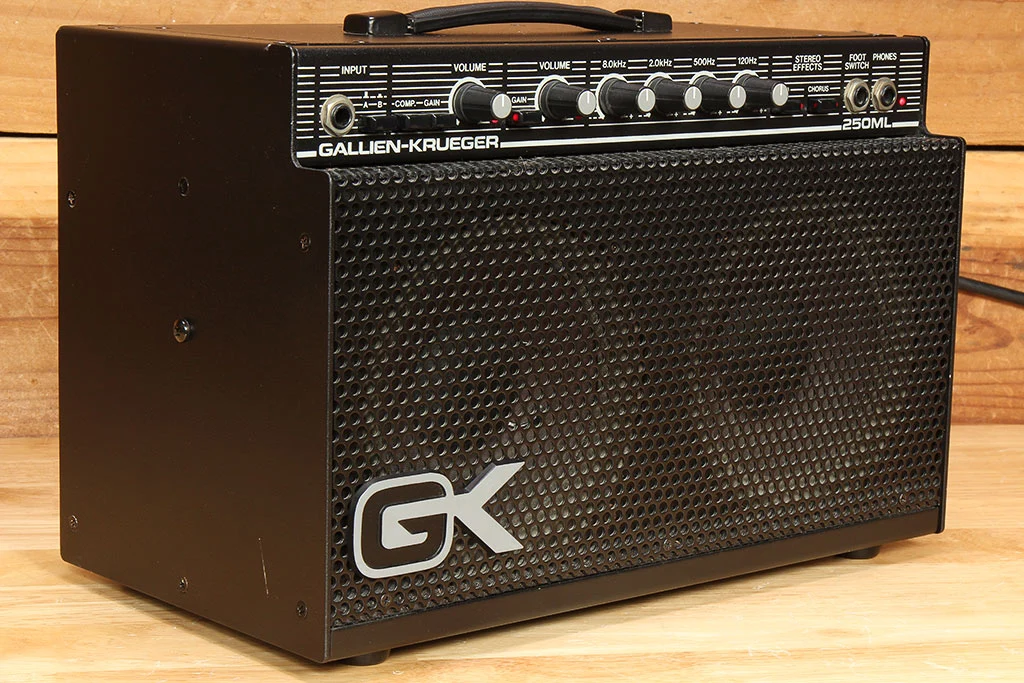
There was a time when “solid-state” was practically an insult in guitar circles. Walk into any music shop in the early ’80s and the hierarchy was unspoken but absolute: tubes were warm, alive, musical. Transistors were cold, brittle, and something you settled for if you couldn’t afford the real thing. Fender, Peavey, and Randall were all cranking out solid-state combos by the truckload, mostly chasing reliability and price point rather than tone, and most of them did nothing to change anyone’s mind. They were amps you practiced on, not amps you dreamed about.
And then a small company in San Jose — started a decade earlier out of an HP engineer’s garage — decided that was a solvable problem, not a law of physics.
The Lunchbox
Gallien-Krueger had already made its name in bass amplification by the early ’80s, but in 1983 they dropped something strange into the guitar world: the 250ML. It looked like nothing else on a backline — a squat little “lunchbox” enclosure you could carry in one hand, with two 6.5″ speakers and 100 watts of stereo power crammed inside. On paper it sounds like a novelty. In practice, it was a Trojan horse.
The trick was in the preamp. GK’s engineers built the gain stages around op-amps running on an internally boosted ±15V supply — way more headroom than the usual 9V circuits that gave solid-state its reputation for buzzy, fizzy breakup. That extra headroom, combined with careful diode clipping, produced a crunch channel that did something solid-state amps weren’t supposed to do: it felt creamy. Compressed in the right way. Touch-sensitive. People who plugged in expecting a practice amp kept describing it, almost apologetically, as “tube-like” — the highest compliment a solid-state amp could receive in 1985.
Then there was the stereo side of it. A built-in chorus and a spring-simulated “echo,” wired so that if you ran the 250ML into two cabinets, the effect spread wide and enveloping in a way most guitarists had never heard from an amp’s built-in effects before. It wasn’t a gimmick bolted onto a mediocre amp. It was the whole point.
Who Actually Used One
This is the part that made the 250ML more than a curiosity: real, well-known players used it — not as a joke, but as a genuine tool.
Alex Lifeson of Rush was closely associated with the 250ML through the mid-’80s, enough that GK later built a variant explicitly tied to his use of it. Gary Moore talked about his own 250ML Series II in a November 1985 interview with International Musician. Dave Murray and Adrian Smith of Iron Maiden ran them during the Somewhere in Time and Seventh Son of a Seventh Son era — arguably the amp’s highest-profile moment, and the reason it still gets name-checked in metal gear forums forty years later. And David Gilmour — not exactly known for reaching for anything cheap or novelty — recorded the solo on Pink Floyd’s “Sorrow” through a small Gallien-Krueger amp during the A Momentary Lapse of Reason sessions.
Four very different players, four very different genres, all landing on the same odd little lunchbox for the same reason: it did something a “real” tube amp couldn’t do quite as easily, in a footprint nothing else could match.
A Personal Postscript
I bought one of these around 1985, with no idea at the time that the company building it was working about six miles from where I grew up. Bob Gallien was still down the road in San Jose, and I was completely unaware I had access to the source. Kicking myself about that one for a while, honestly — but it’s a nice reminder of how much unglamorous engineering brilliance was quietly happening in backyard garages up and down Silicon Valley in that era, alongside the chips and circuit boards everyone actually associates with the place.
The Good News: You Can Still Get There
For decades this tone lived and died with hardware that’s now forty years old, thermally stressed, and running on speakers that are notorious for crumbling foam surrounds. But the circuit has finally been recreated properly — Master Effects’ Seventh Son pedal is built directly from the 250ML’s preamp topology, same boosted rail voltage and same gain-stage philosophy, not just a vague “inspired by.” I picked one up, and it’s genuinely the real thing in pedal form.
The one catch: the pedal only gives you the preamp. The original amp’s magic was never just the gain stage — it was that gain stage married to a stereo chorus and a spring reverb that made two cabinets feel like a wall of shimmer. Add a chorus pedal and a spring reverb pedal after it and you get the full picture back — at which point it stops being a tribute and starts being genuinely, eerily close to standing in front of the real thing again.
Forty years on, it turns out the “Lunchbox from Hell” wasn’t a fluke. It was just good engineering that the rest of the industry took a few decades to catch up to.
Leave a Reply